Monday, July 13, 2026

Geometric Challenge

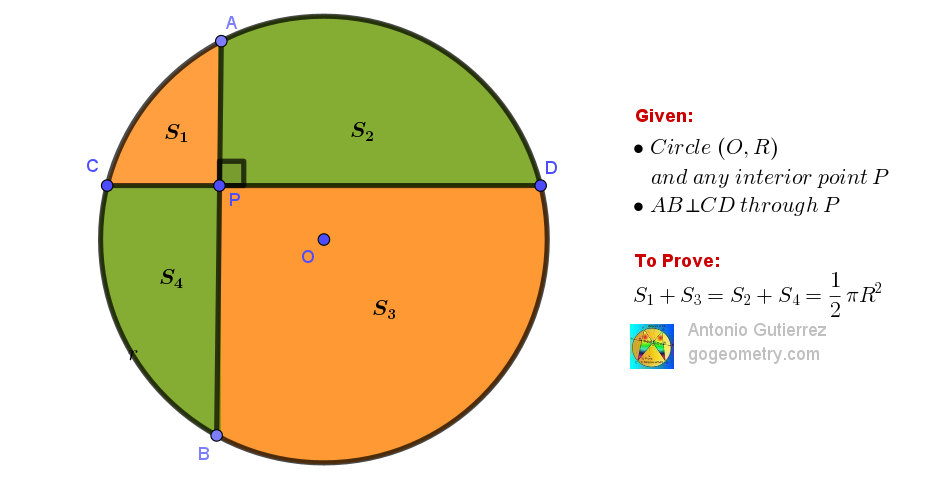
1620 Problem: Perpendicular Chords and Circle Area Invariant

Share your proof or solution in the comments below.
Target Audience: K-12, Honors Geometry, and College Mathematics Education.

Two perpendicular chords partition a circle of radius R into four consecutive regions. Prove that the sum of the areas of non-adjacent regions is invariant.
Explore the full theorem and illustrated diagrams by clicking the image below.

Illustration of Geometry Problem 1620: Perpendicular Chords and Circle Area Invariant
Click for additional details and full diagram.

Proposed Solution
We invite students, teachers, and math enthusiasts to share their insights using synthetic geometry or classical circle properties.

How to contribute:
Post your step-by-step proof in the comments below:
  • Describe the theorems applied.
  • Share a link to your dynamic construction (GeoGebra, Desmos).
Be the first to submit a formal solution for this problem!
Ready to contribute?
Please use the box below to Enter your Comment or Solution. You can use plain text or provide links to your digital proofs.

Saturday, July 11, 2026

Geometric Challenge

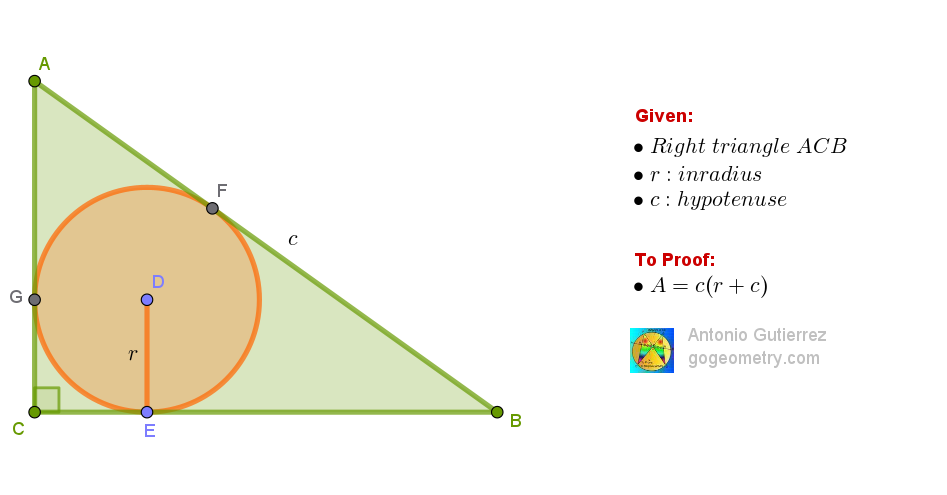
Problem 1619: Right Triangle Area in terms of Inradius and Hypotenuse

Share your proof or solution in the comments below.
Target Audience: K-12, Honors Geometry, and College Mathematics Education.

Discover an elegant identity connecting the fundamental metrics of a right triangle. In Problem 1619, we explore how the area relates directly to its inradius and hypotenuse: Area = r(r + c).
Click the image below to view the full problem statement and diagram.

Geometry Problem 1619: Right Triangle Area, Inradius, and Hypotenuse
Click for additional details and full diagram.

Proposed Solution
We invite students, teachers, and math enthusiasts to share their proof. Try using geometric area decomposition or metric properties of tangents.

How to contribute:
Post your step-by-step proof in the comments below. Feel free to:
  • Describe the geometric theorems applied.
  • Share a link to your visual construction (GeoGebra, Desmos).
Be the first to submit a formal solution for this challenge!
Ready to contribute?
Please use the box below to Enter your Comment or Solution.

Saturday, May 30, 2026

The Architecture of AGI: An Interactive Mind Map Explorer

Traditional AI overviews often isolate machine learning from its broader philosophical and physical constraints. But understanding the path to true Artificial General Intelligence demands a far more sophisticated, multi-disciplinary framework.

The AGI State-of-the-Art Mind Map Explorer expands classical AI taxonomies into an interactive, multi-level systems-thinking model capable of tracking cognitive foundations, neuro-symbolic hybrid architectures, alignment safety theory, world models, and underlying hardware boundaries.

This interactive visual taxonomy explores:

  • Cognitive Foundations, Abstract Reasoning, and Human Intelligence Analogies
  • Neuro-Symbolic Hybrid Architectures, Connectionist Systems, and World Models (JEPA)
  • Silicon Physical Limits, Neuromorphic Computing, and Substrate Alternatives
  • General Learning Mechanisms, Self-Supervision, and Continual Adaptation Horizons
  • Dynamic Memory Architectures, Test-Time Compute Scaling, and Causal Search Planes
  • Holistic Indicators (ARC, GAIA), Alignment Theory, Technical Guardrails, and Compute Governance

AGI State-of-the-Art Mind Map Explorer

Explore the Interactive AGI Mind Map →

Sunday, May 24, 2026

Meta-Ecosystem SWOT Taxonomy: A Systems Thinking Framework for Complex Adaptive Networks

Traditional SWOT analysis was designed for isolated organizations. But today's interconnected world demands a far more sophisticated strategic framework.

The Meta-Ecosystem SWOT Taxonomy expands classical SWOT into a multidimensional systems-thinking model capable of analyzing digital ecosystems, innovation networks, governance architectures, collective intelligence systems, AI-driven environments, and complex adaptive structures.

This visual taxonomy explores:

  • Endogenous Dynamics and Systemic Resilience
  • Network Intelligence and Interoperability
  • Governance Models and Structural Fragility
  • Artificial Intelligence and Technological Evolution
  • Cybersecurity, Sustainability, and Systemic Risk
  • Adaptive, Evolutionary, and Mitigation Strategies

Designed for futurists, systems architects, educators, researchers, innovation leaders, and AI strategists, this framework provides a powerful conceptual lens for understanding the emerging complexity of interconnected ecosystems.

Meta-Ecosystem SWOT Taxonomy

Explore the Meta-Ecosystem SWOT Taxonomy →

Sunday, May 17, 2026

Geometry Hidden in the Chino Copper Mine

From space, the El Chino Copper Mine in New Mexico reveals a surprising world of circles, arcs, symmetry, and geometric patterns.

Viewed through Google satellite imagery, massive circular settling tanks, curved roads, and industrial structures transform this mining landscape into a striking example of real-world geometry.

Click below to reveal the complete details.

Thumbnail of a Dance mind map

Sunday, May 3, 2026

Geometric Challenge

1618 Geometry Problem: Altitudes and Semicircles in Harmony

Share your proof or solution in the comments below.
Target Audience: K-12, Honors Geometry, and College Mathematics Education.

Uncover the mathematical elegance hidden within heritage. In Problem 1618, we transition to the "Sacred Geometry" of circular systems. This challenge explores the sophisticated interplay of semicircles and diameters to reveal a striking set of concyclic points, reminiscent of the intentional alignments found in Incan architecture.
Explore the full theorem and illustrated diagrams by clicking the image below.

Illustration of Geometry Problem 1618: Machu Picchu Heritage
Click for additional details and full diagram.

Proposed Solution
We invite students, teachers, and math enthusiasts to share their insights. This challenge involves altitudes and circular properties that can be unlocked using synthetic geometry.

How to contribute:
Post your step-by-step proof in the comments below. Feel free to:
  • Describe the theorems applied.
  • Share a link to your dynamic construction (GeoGebra, Desmos).
Be the first to submit a formal solution for this heritage-themed problem!
Ready to contribute?
Please use the box below to Enter your Comment or Solution. You can use plain text or provide links to your digital proofs.
Sunday, April 19, 2026

Geometric Challenge

Geometry Problem 1617: The Concyclic Hexagon and the Power of Intersecting Circumcircles

Share your proof or solution in the comments below.
Target Audience: K-12, Honors Geometry, and College Mathematics Education.

Discover the hidden symmetry of intersecting systems in Problem 1617. This challenge moves away from simple tangency to explore a more complex configuration where two circles overlap, creating a remarkable "Concyclic Hexagon."
Explore the full theorem and interactive diagrams by clicking the illustration below.

Illustration of Geometry Problem 1617
Click for additional details.

Proposed Solution
We invite students, teachers, and enthusiasts to share their proofs. This classic challenge can be approached using synthetic geometry.

How to contribute:
Post your step-by-step proof in the comments below. Feel free to:
  • Describe your construction and properties applied (centroid/medians).
  • Provide a link to a diagram (GeoGebra, Desmos, etc.) if you have one.
Be the first to submit a formal solution!
Ready to contribute?
Please use the box below to Enter your Comment or Solution. You can use plain text or provide links to your diagrams.

Saturday, April 18, 2026

Geometric Challenge

Geometry Problem 1616: Finding the Missing Segment

Share your proof or solution in the comments below.
Target Audience: K-12, Honors Geometry, and College Mathematics Education.

Problem 1616 presents a challenge in finding a specific segment within a configuration of circles and triangles. This problem tests your ability to identify metric relations and apply synthetic logic to calculate exact lengths.
Explore the full theorem and interactive diagrams by clicking the illustration below.

Illustration of Geometry Problem 1616
Click for additional details.

Proposed Solution
We invite students, teachers, and enthusiasts to share their proofs. This classic challenge can be approached using synthetic geometry.

How to contribute:
Post your step-by-step proof in the comments below. Feel free to:
  • Describe your construction and properties applied (centroid/medians).
  • Provide a link to a diagram (GeoGebra, Desmos, etc.) if you have one.
Be the first to submit a formal solution!
Ready to contribute?
Please use the box below to Enter your Comment or Solution. You can use plain text or provide links to your diagrams.

Thursday, April 2, 2026

Geometric Challenge

Problem 1615 -Quadrilateral, Midpoints, and Area Invariance, Synthetic Geometry.

Geometry Challenge 1615: Share your proof or solution in the comments below.
Target Audience: K-12, Honors Geometry, and College Mathematics Education.

Explore the full theorem and interactive diagrams by clicking the illustration below.

Illustration of Geometry Problem 1615
Click for additional details.

Proposed Solution
We invite students, teachers, and enthusiasts to share their proofs. This classic challenge can be approached using synthetic geometry.

How to contribute:
Post your step-by-step proof in the comments below. Feel free to:
  • Describe your construction and properties applied (centroid/medians).
  • Provide a link to a diagram (GeoGebra, Desmos, etc.) if you have one.
Be the first to submit a formal solution!
Ready to contribute?
Please use the box below to Enter your Comment or Solution. You can use plain text or provide links to your diagrams.

Saturday, March 14, 2026

Geometric Challenge

Problem 1614 - Area Equivalence in a Semicircle with Inscribed Rectangles, Synthetic Geometry.

Geometry Challenge 1614: Share your proof or solution in the comments below.
Target Audience: K-12, Honors Geometry, and College Mathematics Education.

Explore the full theorem and interactive diagrams by clicking the illustration below.

Illustration of Geometry Problem 1614
Click for additional details.

Proposed Solution
We invite students, teachers, and enthusiasts to share their proofs. This classic challenge can be approached using synthetic geometry.

How to contribute:
Post your step-by-step proof in the comments below. Feel free to:
  • Describe your construction and properties applied (centroid/medians).
  • Provide a link to a diagram (GeoGebra, Desmos, etc.) if you have one.
Be the first to submit a formal solution!
Ready to contribute?
Please use the box below to Enter your Comment or Solution. You can use plain text or provide links to your diagrams.