Share your proof or solution in the comments below.
Target Audience: K-12, Honors Geometry, and College Mathematics Education.
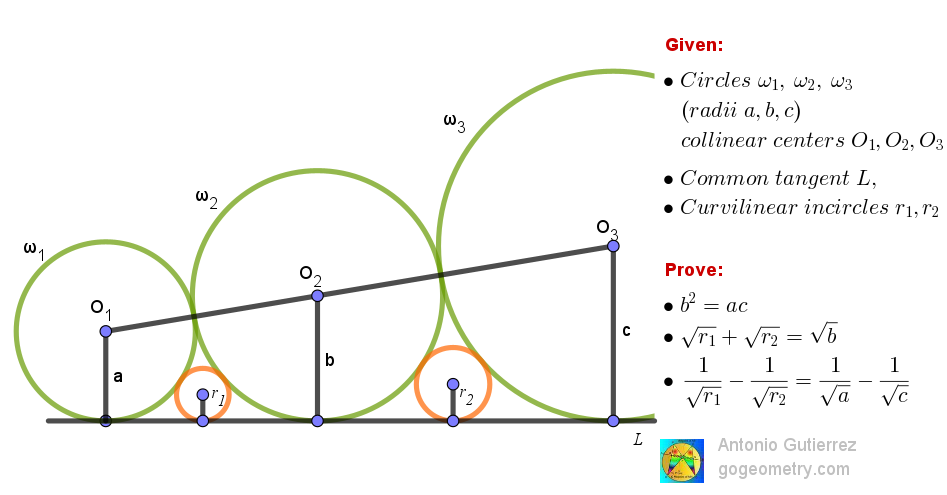
In Problem 1627, we explore three mutually tangent circles with collinear centers and a common external tangent line. The challenge is to prove using synthetic similarity that the radii satisfy a geometric progression, and to establish the elegant radical and harmonic difference relations involving the radii of their curvilinear inscribed circles.
Explore the full theorem and illustrated diagram by clicking the image below.
Target Audience: K-12, Honors Geometry, and College Mathematics Education.
In Problem 1627, we explore three mutually tangent circles with collinear centers and a common external tangent line. The challenge is to prove using synthetic similarity that the radii satisfy a geometric progression, and to establish the elegant radical and harmonic difference relations involving the radii of their curvilinear inscribed circles.
Explore the full theorem and illustrated diagram by clicking the image below.
Click for additional details and full diagram.
How to contribute:
Post your step-by-step proof in the comments below. Feel free to:
Post your step-by-step proof in the comments below. Feel free to:
- Describe the theorems applied.
- Share a link to your digital proofs (GeoGebra, Desmos).
Ready to contribute?
Please use the box below to Enter your Comment or Solution. You can use plain text or provide links to your digital proofs.
Please use the box below to Enter your Comment or Solution. You can use plain text or provide links to your digital proofs.