Showing posts with label Synthetic Geometry. Show all posts

Thursday, October 15, 2026

Geometric Challenge

Problem 1627: Three Mutually Tangent Circles, Collinear Centers, and Curvilinear Incircle Radii Relations

Share your proof or solution in the comments below.
Target Audience: K-12, Honors Geometry, and College Mathematics Education.

In Problem 1627, we explore three mutually tangent circles with collinear centers and a common external tangent line. The challenge is to prove using synthetic similarity that the radii satisfy a geometric progression, and to establish the elegant radical and harmonic difference relations involving the radii of their curvilinear inscribed circles.
Explore the full theorem and illustrated diagram by clicking the image below.
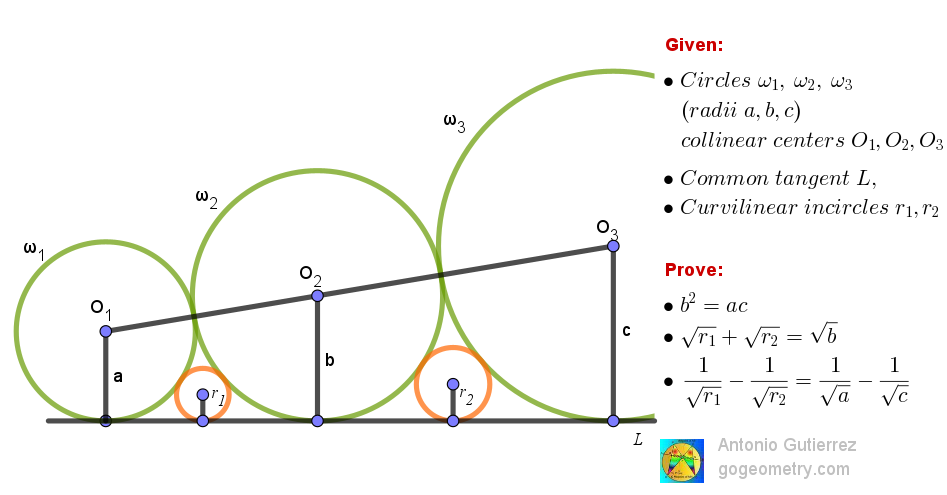
Illustration of Geometry Problem 1627: Three Mutually Tangent Circles and Collinear Centers
Click for additional details and full diagram.

How to contribute:
Post your step-by-step proof in the comments below. Feel free to:
  • Describe the theorems applied.
  • Share a link to your digital proofs (GeoGebra, Desmos).
Be the first to submit a formal solution for this problem!
Ready to contribute?
Please use the box below to Enter your Comment or Solution. You can use plain text or provide links to your digital proofs.

Thursday, September 17, 2026

Geometric Challenge

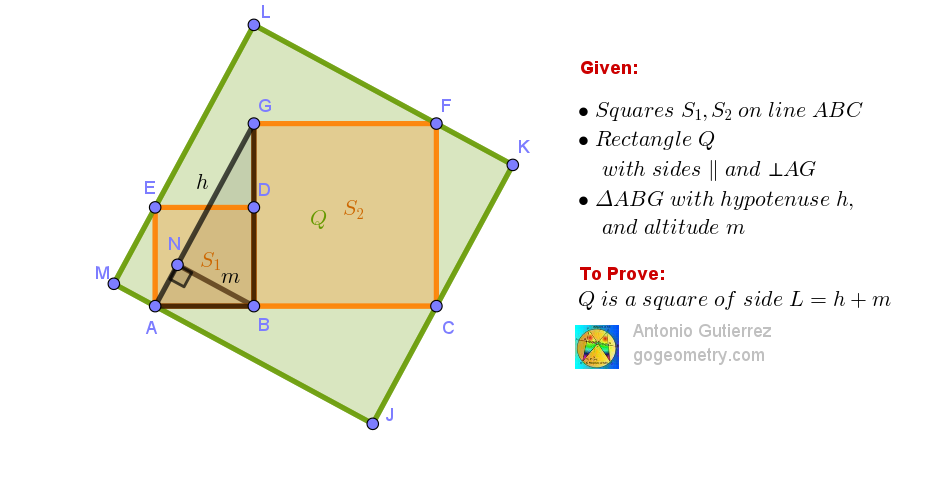
Problem 1623: Two Adjacent Squares and Bounding Square Proof

Share your proof or solution in the comments below.
Target Audience: K-12, Honors Geometry, and College Mathematics Education.

In Problem 1623, we explore two adjacent squares constructed on a straight line. A bounding rectangle circumscribes both squares with its sides aligned parallel and perpendicular to an auxiliary segment. The challenge is to prove using pure triangle congruence that this bounding rectangle is strictly a square, and that its side length L equals the sum of the auxiliary segment length h and the altitude m drawn to it.
Explore the full theorem and illustrated diagram by clicking the image below.

Illustration of Geometry Problem 1623: Two Adjacent Squares and Bounding Square Proof
Click for additional details and full diagram.

How to contribute:
Post your step-by-step proof in the comments below. Feel free to:
  • Describe the theorems applied.
  • Share a link to your dynamic construction (GeoGebra, Desmos).
Be the first to submit a formal solution for this problem!
Ready to contribute?
Please use the box below to Enter your Comment or Solution. You can use plain text or provide links to your digital proofs.
Tuesday, July 21, 2026

Geometric Challenge

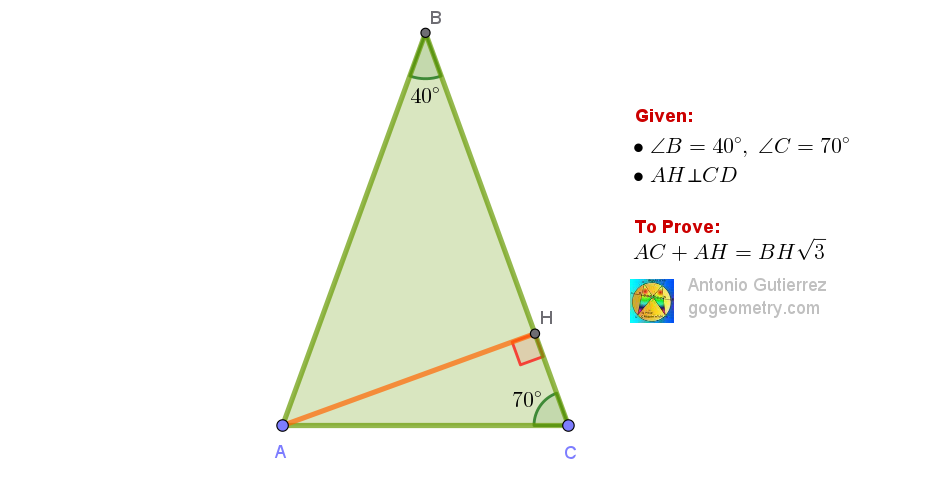
Problem 1621: Isosceles Triangle, 40-70 Degrees, Altitude, Segment Identity

Share your proof or solution in the comments below.
Target Audience: K-12, Honors Geometry, and College Mathematics Education.

In Problem 1621, we explore an isosceles triangle with angles 40 and 70, revealing a striking linear identity involving its altitude and side lengths: AC + AH .
Explore the full theorem and illustrated diagram by clicking the image below.

Illustration of Geometry Problem 1621: Isosceles Triangle, 40-70 Degrees, Altitude
Click for additional details and full diagram.

Proposed Solution
We invite students, teachers, and math enthusiasts to share their insights. This challenge involves angle splits and auxiliary constructions unlocked via synthetic geometry.

How to contribute:
Post your step-by-step proof in the comments below. Feel free to:
  • Describe the theorems applied.
  • Share a link to your dynamic construction (GeoGebra, Desmos).
Be the first to submit a formal solution for this problem!
Ready to contribute?
Please use the box below to Enter your Comment or Solution. You can use plain text or provide links to your digital proofs.
Saturday, March 14, 2026

Geometric Challenge

Problem 1614 - Area Equivalence in a Semicircle with Inscribed Rectangles, Synthetic Geometry.

Geometry Challenge 1614: Share your proof or solution in the comments below.
Target Audience: K-12, Honors Geometry, and College Mathematics Education.

Explore the full theorem and interactive diagrams by clicking the illustration below.

Illustration of Geometry Problem 1614
Click for additional details.

Proposed Solution
We invite students, teachers, and enthusiasts to share their proofs. This classic challenge can be approached using synthetic geometry.

How to contribute:
Post your step-by-step proof in the comments below. Feel free to:
  • Describe your construction and properties applied (centroid/medians).
  • Provide a link to a diagram (GeoGebra, Desmos, etc.) if you have one.
Be the first to submit a formal solution!
Ready to contribute?
Please use the box below to Enter your Comment or Solution. You can use plain text or provide links to your diagrams.