Share your proof or solution in the comments below.
Target Audience: K-12, Honors Geometry, and College Mathematics Education.
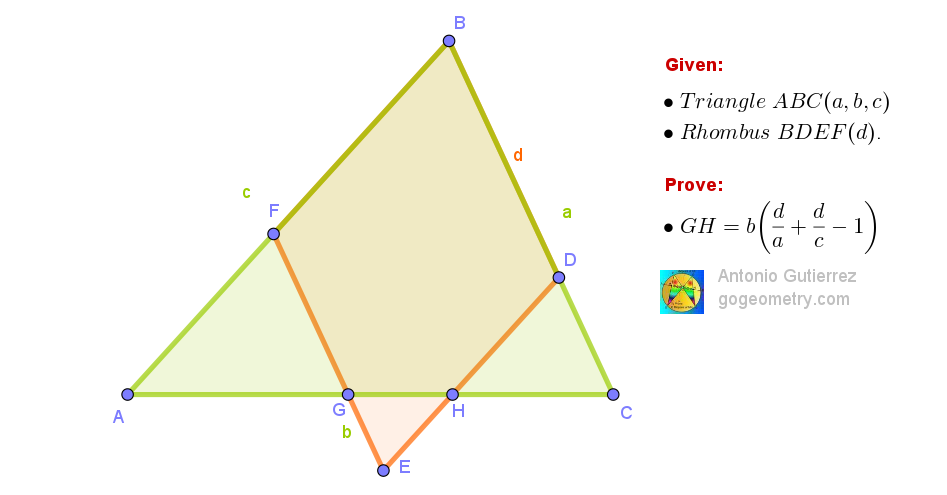
In Problem 1626, we explore a triangle ABC with side lengths a, b, and c, containing an inscribed rhombus BDEF of side length d. Intersecting lines from the rhombus vertices form specific segments along the sides of the triangle. The challenge is to prove that the length of the segment GH can be elegantly expressed in terms of the triangle sides and the rhombus side length as GH = b (d/a + d/c - 1).
Explore the full theorem and illustrated diagram by clicking the image below.
Target Audience: K-12, Honors Geometry, and College Mathematics Education.
In Problem 1626, we explore a triangle ABC with side lengths a, b, and c, containing an inscribed rhombus BDEF of side length d. Intersecting lines from the rhombus vertices form specific segments along the sides of the triangle. The challenge is to prove that the length of the segment GH can be elegantly expressed in terms of the triangle sides and the rhombus side length as GH = b (d/a + d/c - 1).
Explore the full theorem and illustrated diagram by clicking the image below.
Click for additional details and full diagram.
How to contribute:
Post your step-by-step proof in the comments below. Feel free to:
Post your step-by-step proof in the comments below. Feel free to:
- Describe the theorems applied.
- Share a link to your dynamic construction (GeoGebra, Desmos).
Ready to contribute?
Please use the box below to Enter your Comment or Solution. You can use plain text or provide links to your digital proofs.
Please use the box below to Enter your Comment or Solution. You can use plain text or provide links to your digital proofs.


From GF//CB
ReplyDeleteAG:AC = AF:AB
AG:b = c-d:c
Therefore, AG = b(c-d)/c
Similarly, from HD//FE
CH:b = a-d:a
Therefore, CH = b(a-d)/a
GH = b - AG - CH
= b(d/a + d/c - 1).
https://photos.app.goo.gl/Z3Fa5cB8d9HNP9G8A
ReplyDelete