Share your proof or solution in the comments below.
Target Audience: K-12, Honors Geometry, and College Mathematics Education.
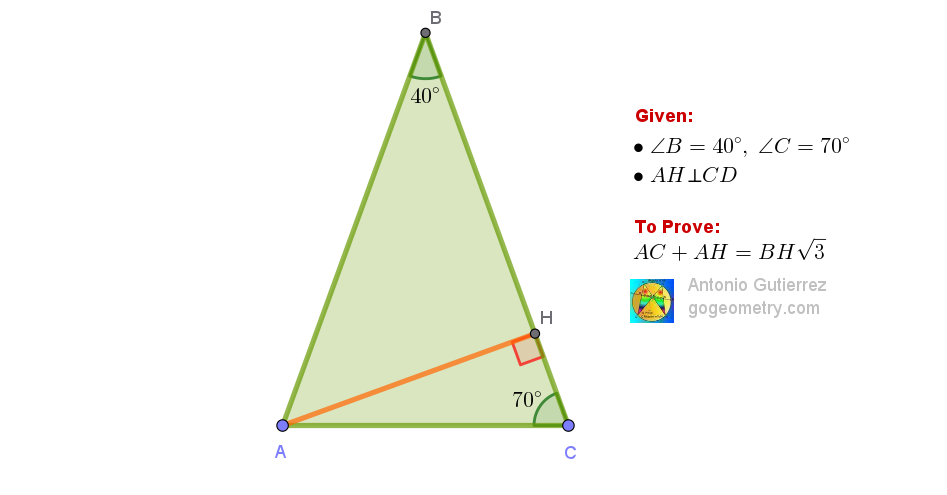
In Problem 1621, we explore an isosceles triangle with angles 40 and 70, revealing a striking linear identity involving its altitude and side lengths: AC + AH .
Explore the full theorem and illustrated diagram by clicking the image below.
Target Audience: K-12, Honors Geometry, and College Mathematics Education.
In Problem 1621, we explore an isosceles triangle with angles 40 and 70, revealing a striking linear identity involving its altitude and side lengths: AC + AH .
Explore the full theorem and illustrated diagram by clicking the image below.
Click for additional details and full diagram.
Proposed Solution
We invite students, teachers, and math enthusiasts to share their insights. This challenge involves angle splits and auxiliary constructions unlocked via synthetic geometry.
How to contribute:
Post your step-by-step proof in the comments below. Feel free to:
We invite students, teachers, and math enthusiasts to share their insights. This challenge involves angle splits and auxiliary constructions unlocked via synthetic geometry.
How to contribute:
Post your step-by-step proof in the comments below. Feel free to:
- Describe the theorems applied.
- Share a link to your dynamic construction (GeoGebra, Desmos).
Ready to contribute?
Please use the box below to Enter your Comment or Solution. You can use plain text or provide links to your digital proofs.
Please use the box below to Enter your Comment or Solution. You can use plain text or provide links to your digital proofs.


Unfortunately, this is a proof using trigonometry rather than geometry.
ReplyDeleteIn △AHB, by the Law of Sines, BH = (sin 50° / sin 40°)AH.
Here, applying the angle sum formula to sin 50° and sin 40°, we get
BH = {(√3 sin 20° + cos 20°) / (4 sin 20° cos 20°)}AH
Also, from △ACH, AC = AH / cos 20°.
Therefore, AC + AH - √3BH = AH / cos 20° + AH - {(√3 sin 20° + cos 20°) / (4 sin 20° cos 20°)} AH
= {(4 sin 20° + 4 sin 20° cos 20° - 3 sin 20° - √3 cos 20°) / (4 sin 20° cos 20°)} AH
= {(sin 20° - √3 cos 20° + 4 sin 20° cos 20°) / (4 sin 20° cos 20°)} AH
Now, by the composition of trigonometric functions,
={(-2sin40°+4sin20°cos20°)/(4sin20°cos20°)}AH
=0
Therefore, AC + AH = BH√3 holds true.
A synthetic way, as suggested by the site owner at: https://stanfulger.blogspot.com/2026/07/httpsgogeometryblogspotcom202607geometr.html
ReplyDeletePure Geometry Solution
ReplyDeleteLet AC = b
Extend HA to E, such that < BEH = 30
Draw BD perpendicular to AC, D on AC
Draw AF perpendicular to BE, F on BE
Triangles AFB & ADB are congruent ASA (20 - 90 - AB common) and so
AF = b/2
Now since AFE is a 30 - 60 - 90 Triangle AE = 2.AF = b
Hence EH = AE + AH = b + h = AC + AH
But EH = BH V3 since Triangle EBH is 30 - 60 -90
Therefore EH = AC + AH = V3. BH
Sumith Peiris
Moratuwa
Sri Lanka
Brilliant!
ReplyDelete