Share your proof or solution in the comments below.
Target Audience: K-12, Honors Geometry, and College Mathematics Education.
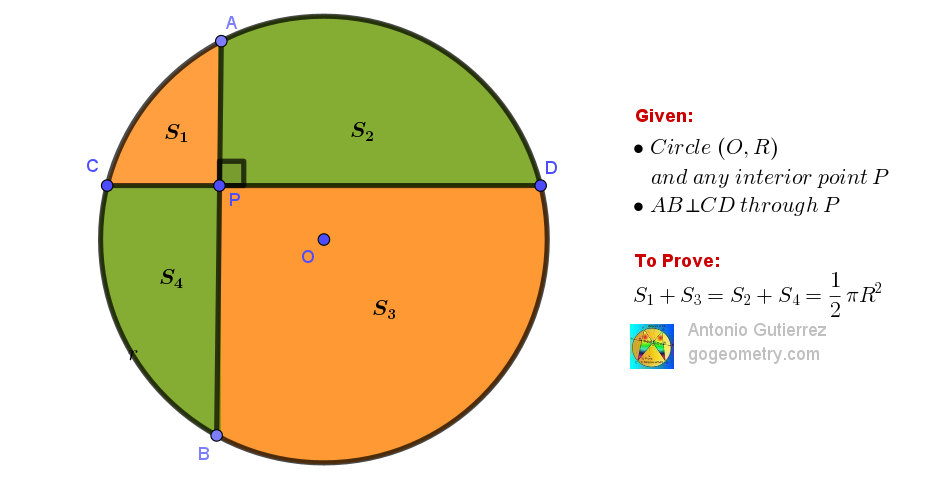
Uncover the mathematical elegance hidden within a circle. In Problem 1620, we explore how two perpendicular chords partition a circle into four curvilinear regions to reveal a remarkable hidden area difference invariant.
Explore the full theorem and illustrated diagrams by clicking the image below.
Target Audience: K-12, Honors Geometry, and College Mathematics Education.
Uncover the mathematical elegance hidden within a circle. In Problem 1620, we explore how two perpendicular chords partition a circle into four curvilinear regions to reveal a remarkable hidden area difference invariant.
Explore the full theorem and illustrated diagrams by clicking the image below.
Click for additional details and full diagram.
Proposed Solution
We invite students, teachers, and math enthusiasts to share their insights. This challenge involves perpendicular chords, Archimedes' Theorem, and curvilinear areas that can be unlocked using geometry.
How to contribute:
Post your step-by-step proof in the comments below. Feel free to:
We invite students, teachers, and math enthusiasts to share their insights. This challenge involves perpendicular chords, Archimedes' Theorem, and curvilinear areas that can be unlocked using geometry.
How to contribute:
Post your step-by-step proof in the comments below. Feel free to:
- Describe the theorems applied (e.g., Intersecting Chords, Archimedes).
- Share a link to your dynamic construction (GeoGebra, Desmos).
Ready to contribute?
Please use the box below to Enter your Comment or Solution. You can use plain text or provide links to your digital proofs.
Please use the box below to Enter your Comment or Solution. You can use plain text or provide links to your digital proofs.


(a) By the properties of inscribed angles, ∠CAB = ∠CDB.
ReplyDeleteTherefore, △CAP is similar to △BDP.
Since AD:DP = CP:BP—that is, a:d = c:b—we have a·b = c·d.
(b) Draw line segment EF through O and parallel to CD (in the same order as CD). Furthermore, draw line segment C'D' such that it is symmetric with respect to EF. Similarly, draw line segment GH through O and parallel to AB, and line segment A'B' such that it is symmetric with respect to GH.
Since arc AC = arc C'B and arc DF = arc EC', the sum of arc AC and arc BD is
half the circumference.
Therefore, if the central angle of arc BD is θ, the central angle of arc AC is π − θ.
Since a² + c² = AC² and b² + d² = BD², and by the law of cosines,
AC² = R² + R² − 2R·R·cos(π − θ)
BD² = R² + R² − 2R·R·cosθ
Therefore, a² + b² + c² + d² = 4R².
(c) If we move the orange region containing arc AC to the green region containing arc BC', and move the orange region enclosed by arcs DF, CD, EF, and A'B' to the green region (symmetric about the origin O) containing arc EC', the result is a semicircle plus a rectangle. One side of the rectangle is |(c+d)-2c| = |d-c|, and the other is |(a+b)-2a|/2 = |b-a|/2.
Therefore, we obtain the equation in (c).
(d) Since (c) shows that the figure is a semicircle minus a rectangle, we obtain the equation in (d).