Share your proof or solution in the comments below.
Target Audience: K-12, Honors Geometry, and College Mathematics Education.
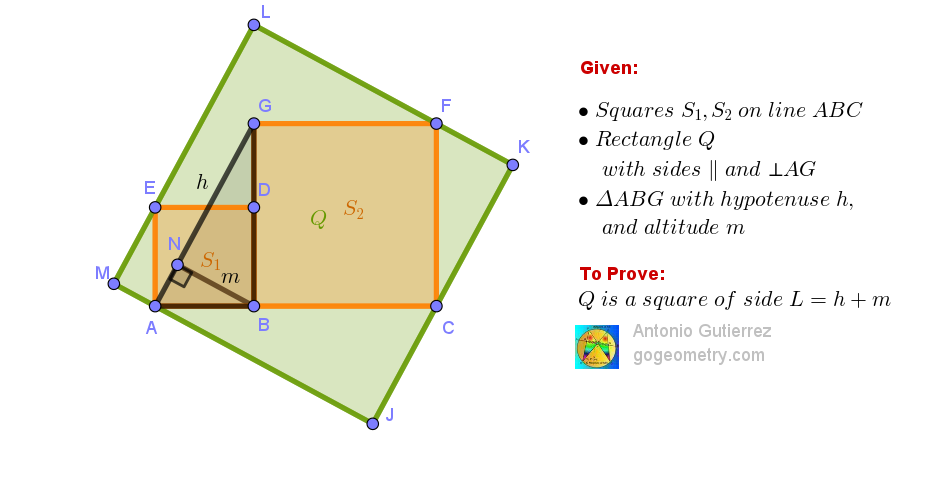
In Problem 1623, we explore two adjacent squares constructed on a straight line. A bounding rectangle circumscribes both squares with its sides aligned parallel and perpendicular to an auxiliary segment. The challenge is to prove using pure triangle congruence that this bounding rectangle is strictly a square, and that its side length L equals the sum of the auxiliary segment length h and the altitude m drawn to it.
Explore the full theorem and illustrated diagram by clicking the image below.
Target Audience: K-12, Honors Geometry, and College Mathematics Education.
In Problem 1623, we explore two adjacent squares constructed on a straight line. A bounding rectangle circumscribes both squares with its sides aligned parallel and perpendicular to an auxiliary segment. The challenge is to prove using pure triangle congruence that this bounding rectangle is strictly a square, and that its side length L equals the sum of the auxiliary segment length h and the altitude m drawn to it.
Explore the full theorem and illustrated diagram by clicking the image below.
Click for additional details and full diagram.
How to contribute:
Post your step-by-step proof in the comments below. Feel free to:
Post your step-by-step proof in the comments below. Feel free to:
- Describe the theorems applied.
- Share a link to your dynamic construction (GeoGebra, Desmos).
Ready to contribute?
Please use the box below to Enter your Comment or Solution. You can use plain text or provide links to your digital proofs.
Please use the box below to Enter your Comment or Solution. You can use plain text or provide links to your digital proofs.


Let A' be the point where the extension of AG intersects LK.
ReplyDeleteSince △NGB ≡ △A'FG,
LM = AA' = h + m.
Furthermore,
since △NBA ≡ △MAE, LF = h,
and since △NGB ≡ △KCF, FK = m.
Therefore, LK = h + m.
Q is a square with a side length of h + m.
Let AN = u so that GN = h - u
ReplyDeleteIf AG meets LK at X we have
Triangles GFX & NBG congruent ASA
So GX = m and AX = h + m = LM ............(1)
Triangles AME & ABN are also congruent ASA
So AM = u
But Triangles GFX & BNG are congruent ASA
So XF = h - u which gives
LF = LX + FX = AM + XF = u + (h -u) = h ...........(2)
Now since CKF & BNG are congruent ASA
FK = m ...... (3)
Hence LK = h + m (from (2) & (3))
So LM = LK = h + m
Thus LMJK is a square of side h + m
Sumith Peiris
Moratuwa
Sri Lanka