Share your proof or solution in the comments below.
Target Audience: K-12, Honors Geometry, and College Mathematics Education.
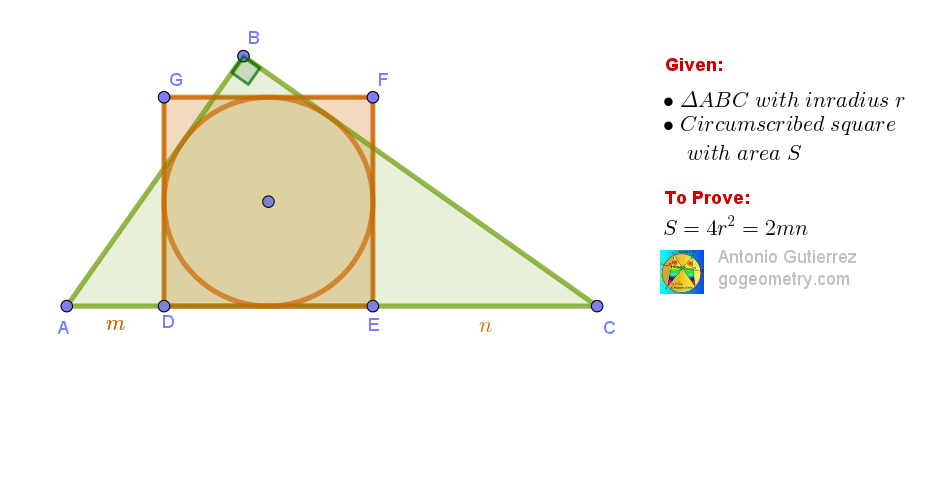
In Problem 1624, we explore a right triangle and a square circumscribed about its incircle with one side resting on the hypotenuse. The challenge is to prove that the area of the square S and the inradius r satisfy the fundamental geometric mean identity S = 4r² = 2mn, where m and n are the hypotenuse segments adjacent to the square.
Explore the full theorem and illustrated diagram by clicking the image below.
Target Audience: K-12, Honors Geometry, and College Mathematics Education.
In Problem 1624, we explore a right triangle and a square circumscribed about its incircle with one side resting on the hypotenuse. The challenge is to prove that the area of the square S and the inradius r satisfy the fundamental geometric mean identity S = 4r² = 2mn, where m and n are the hypotenuse segments adjacent to the square.
Explore the full theorem and illustrated diagram by clicking the image below.
Click for additional details and full diagram.
How to contribute:
Post your step-by-step proof in the comments below. Feel free to:
Post your step-by-step proof in the comments below. Feel free to:
- Describe the theorems applied.
- Share a link to your dynamic construction (GeoGebra, Desmos).
Ready to contribute?
Please use the box below to Enter your Comment or Solution. You can use plain text or provide links to your digital proofs.
Please use the box below to Enter your Comment or Solution. You can use plain text or provide links to your digital proofs.


https://photos.app.goo.gl/rnYmrMYowAiYjThH8
ReplyDeleteDefine points P, Q , M, N, I and angles u, v per sketch
We have BP=EQ=r => NB= NE
And points A, I, N are colinear
Similarly with points M, I, C
Since I is incenter of ABC => ∠(AIC)= 135 and triangle DIE is right isosceles
And we have u+v= 135-90= 45
Angle (IAD)= 45- u = 45-(45-v)= v= angle ( EIC)
Triangle AID similar to ICE ( case AA)
So AD/IE= ID/EC => m. n= IE^2= 2.r^2
Let P, Q, and R be the points of tangency of the incircle of △ABC (radius r) with the line segments AB, BC, and CA, respectively.
ReplyDeleteAP = AR = m + r
BP = BQ = r
CQ = CR = n + r
The area of △ABC is
(1/2) * AB * BC = (1/2) * r * (AB + BC + CA), so
(1/2) * (m + 2r) * (n + 2r) = (1/2) * r * (m + 2r + n + 2r + m + n + 2r)
Therefore, mn = 2*r^2
That is, S = 4*r^2 = 2mn
Given the conditions above, rather than using an equation for the area of triangle ABC, we can derive a similar equation from the Pythagorean theorem:
ReplyDelete(m+2r)^2 + (n+2r)^2 = (m+n+2r)^2
Very good solution
DeleteActually, Antonio has given the solution in his Strategic Hints
ReplyDeleteOnce we realize that Triangles ADI and CEI are similar it is pretty straightforward