Share your proof or solution in the comments below.
Target Audience: K-12, Honors Geometry, and College Mathematics Education.
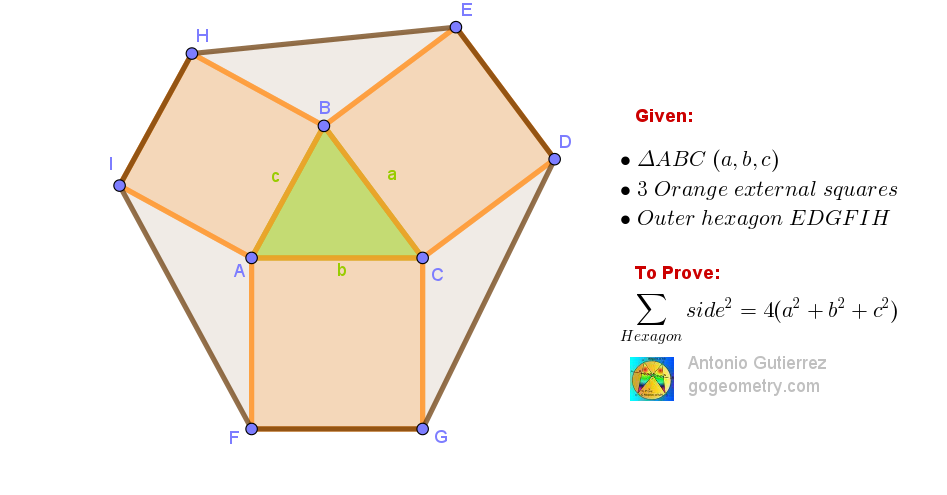
In Problem 1622, we explore a triangle with external squares on each side, forming an outer hexagon. The challenge is to prove that the sum of the squares of the six sides of the outer hexagon equals four times the sum of the squares of the original triangle's sides.
Explore the full theorem and illustrated diagram by clicking the image below.
Target Audience: K-12, Honors Geometry, and College Mathematics Education.
In Problem 1622, we explore a triangle with external squares on each side, forming an outer hexagon. The challenge is to prove that the sum of the squares of the six sides of the outer hexagon equals four times the sum of the squares of the original triangle's sides.
Explore the full theorem and illustrated diagram by clicking the image below.
Click for additional details and full diagram.
How to contribute:
Post your step-by-step proof in the comments below. Feel free to:
Post your step-by-step proof in the comments below. Feel free to:
- Describe the theorems applied.
- Share a link to your dynamic construction (GeoGebra, Desmos).
Ready to contribute?
Please use the box below to Enter your Comment or Solution. You can use plain text or provide links to your digital proofs.
Please use the box below to Enter your Comment or Solution. You can use plain text or provide links to your digital proofs.


Let HE = u, DG = v & FI = w
ReplyDeleteUsing Cosine Rule in Triangles ABC and BEH,
Cos B = (a^2 + c^2 - b^2)/(2ac) and u^2 = a^2 + c^2 + 2ac Cos B
Thus u^2 = 2.a^2 + 2.c^2 -b^2 ......(1)
Similarly
v^2 = 2.a^2 + 2.b^2 - c^2 ......(2) and
w^2 = 2b^2 + 2c^2 - a^2 ......(3)
Adding,
u^2 + v^2 + w^2 = 3(a^2 + b^2 + c^2)
Now add to this the squares of HI (= c), DE (= a) and BF (= b) which yields that the sum of the squares on the 6 sides of the outer Hexagon = 4 (a^2 + b^2 + c^2)
Sumith Peiris
Moratuwa
Sri Lanka
Solution 2 - Pure Geometry Solution (without using Cosine Rule)
DeleteLet BX be an altitude of Triangle ABC, X on AC
Extend XB to Y such that BY = b
Then < YBH = A and Triangles ABC & YBH are congruent SAS
Similarly < YBE = C and Triangles ABC & YBE are congruent SAS
Hence HY = a = BE and HB = c = YE
Hence in Quadrilateral BHYE, the opposite sides are equal and hence the same is a parallelogram with the diagonals bisecting each other.
Now using Apollonius Theorem in Triangle BHE,
a^2 + c^2 = 2(u/2)^2 + 2(b/2)^2 from which,
u^2 = 2.a^2 + 2.c^2 - b^2 as before
From here onwards the proof is the same as in my earlier solution above
Sumith Peiris
Moratuwa
Sri Lanka
Solution 3 - Pure Geometry Solution
DeleteExtend HB to U such that HB = BU = c
Now < UBE = B hence Triangles BUE & ABC are congruent SAS
Now apply Apollonius to Triangle HEU in which EB is a median
u^2 + b^2 = 2.a^2 + 2.c^2 as before
The rest of the proof is the same as above
Sumith Peiris
Moratuwa
Sri Lanka
Let the interior angles of △ABC be A, B, and C, respectively.
ReplyDeleteIn △BEH, by the law of cosines,
HE² = BH² + BE² - 2BHBE cos(180° - B)
= c² + a² + 2ca * cos B
Here, applying the law of cosines to triangle ABC,
we substitute cos B = (a² + c² - b²)/(2ac) into the above equation,
yielding HE² = 2(a² + c²) - b².
Similarly,
IF² = 2(b² + c²) - a²
GD² = 2(a² + b²) − b²
Therefore, Σsides² = 4(a² + b² + c²)