Share your proof or solution in the comments below.
Target Audience: K-12, Honors Geometry, and College Mathematics Education.
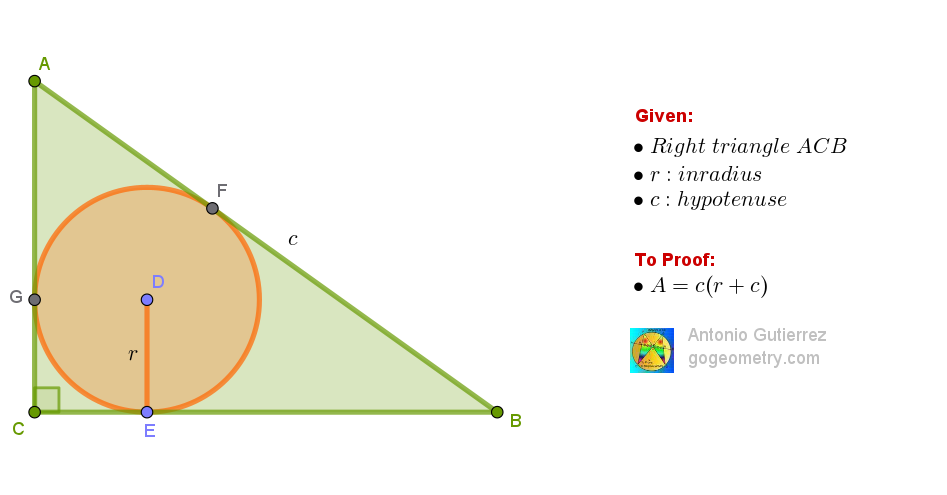
Discover an elegant identity connecting the fundamental metrics of a right triangle. In Problem 1619, we explore how the area relates directly to its inradius and hypotenuse: Area = r(r + c).
Click the image below to view the full problem statement and diagram.
Target Audience: K-12, Honors Geometry, and College Mathematics Education.
Discover an elegant identity connecting the fundamental metrics of a right triangle. In Problem 1619, we explore how the area relates directly to its inradius and hypotenuse: Area = r(r + c).
Click the image below to view the full problem statement and diagram.
Click for additional details and full diagram.
Proposed Solution
We invite students, teachers, and math enthusiasts to share their proof. Try using geometric area decomposition or metric properties of tangents.
How to contribute:
Post your step-by-step proof in the comments below. Feel free to:
We invite students, teachers, and math enthusiasts to share their proof. Try using geometric area decomposition or metric properties of tangents.
How to contribute:
Post your step-by-step proof in the comments below. Feel free to:
- Describe the geometric theorems applied.
- Share a link to your visual construction (GeoGebra, Desmos).
Ready to contribute?
Please use the box below to Enter your Comment or Solution.
Please use the box below to Enter your Comment or Solution.


With the usual notation for any Triangle ABC,
ReplyDeleteIn the Right Triangle ABC,
AG = b - r = AF and BE = a - r = BF
Hence c = AF + BF = a + b - 2r
So 2r = a +b - c = 2s - 2c
and s = r + c....(1)
But A = r.s
Therefore from (1),
A = r(r + c)
Sumith Peiris
Moratuwa
Sri Lanka