Share your proof or solution in the comments below.
Target Audience: K-12, Honors Geometry, and College Mathematics Education.
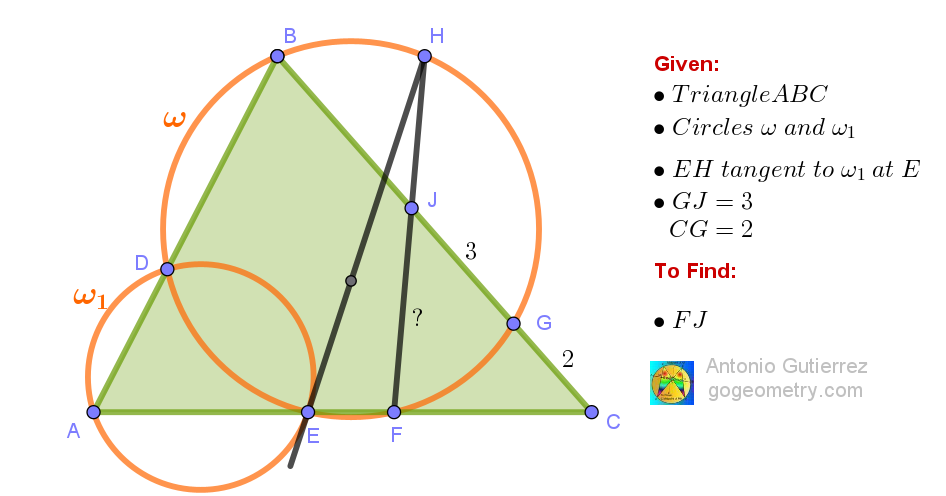
Discover the hidden symmetry of intersecting systems in Problem 1617. This challenge moves away from simple tangency to explore a more complex configuration where two circles overlap, creating a remarkable "Concyclic Hexagon."
Explore the full theorem and interactive diagrams by clicking the illustration below.
Target Audience: K-12, Honors Geometry, and College Mathematics Education.
Discover the hidden symmetry of intersecting systems in Problem 1617. This challenge moves away from simple tangency to explore a more complex configuration where two circles overlap, creating a remarkable "Concyclic Hexagon."
Explore the full theorem and interactive diagrams by clicking the illustration below.
Click for additional details.
Proposed Solution
We invite students, teachers, and enthusiasts to share their proofs. This classic challenge can be approached using synthetic geometry.
How to contribute:
Post your step-by-step proof in the comments below. Feel free to:
We invite students, teachers, and enthusiasts to share their proofs. This classic challenge can be approached using synthetic geometry.
How to contribute:
Post your step-by-step proof in the comments below. Feel free to:
- Describe your construction and properties applied (centroid/medians).
- Provide a link to a diagram (GeoGebra, Desmos, etc.) if you have one.
Ready to contribute?
Please use the box below to Enter your Comment or Solution. You can use plain text or provide links to your diagrams.
Please use the box below to Enter your Comment or Solution. You can use plain text or provide links to your diagrams.


Extend AB to Y.
ReplyDeleteSince HE is tangential to Circle ADE at E, < DEH = < DAE = A
But < YBH = < DEH = A
Hence BH // AC
So < ACB = C = < CBH = < HFG
This implies that JF is tangential to Circle GFC at F
Hence FJ^2 = JG.JC = 3*(3+2) = 15
Therefore FJ = V15
Sumith Peiris
Moratuwa
Sri Lanka