Share your proof or solution in the comments below.
Target Audience: K-12, Honors Geometry, and College Mathematics Education.
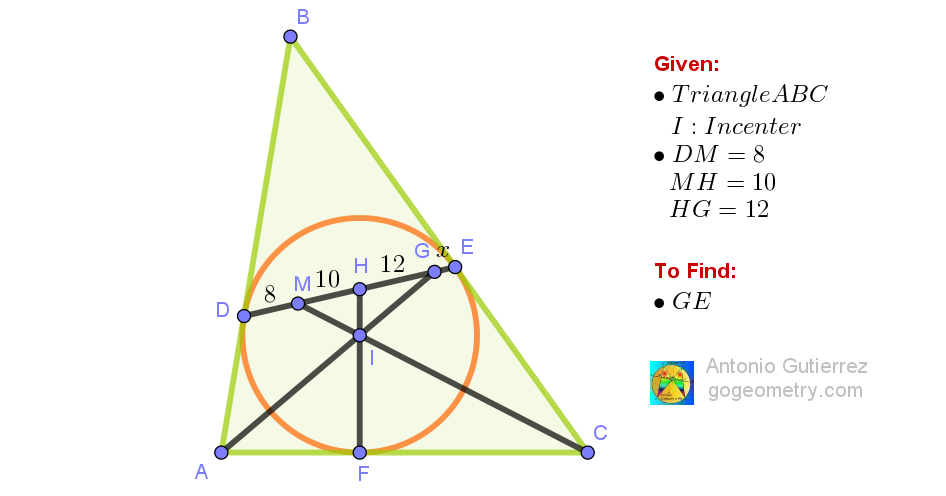
Problem 1616 presents a challenge in finding a specific segment within a configuration of circles and triangles. This problem tests your ability to identify metric relations and apply synthetic logic to calculate exact lengths.
Explore the full theorem and interactive diagrams by clicking the illustration below.
Target Audience: K-12, Honors Geometry, and College Mathematics Education.
Problem 1616 presents a challenge in finding a specific segment within a configuration of circles and triangles. This problem tests your ability to identify metric relations and apply synthetic logic to calculate exact lengths.
Explore the full theorem and interactive diagrams by clicking the illustration below.
Click for additional details.
Proposed Solution
We invite students, teachers, and enthusiasts to share their proofs. This classic challenge can be approached using synthetic geometry.
How to contribute:
Post your step-by-step proof in the comments below. Feel free to:
We invite students, teachers, and enthusiasts to share their proofs. This classic challenge can be approached using synthetic geometry.
How to contribute:
Post your step-by-step proof in the comments below. Feel free to:
- Describe your construction and properties applied (centroid/medians).
- Provide a link to a diagram (GeoGebra, Desmos, etc.) if you have one.
Ready to contribute?
Please use the box below to Enter your Comment or Solution. You can use plain text or provide links to your diagrams.
Please use the box below to Enter your Comment or Solution. You can use plain text or provide links to your diagrams.


ReplyDeleteWell known, AM_|_CM, CG_|_AG and DAFIM, CEGIF are cyclic, FI being their circumcircles' radical axis, that is, MH*DH=HI*HF=HG*HE, or MH*DH=HI*HF, i.e. 10*18=12(12+x), or x=3
BD = BE so < BDE = (A+C)/2 and < AGD = C/2
ReplyDeleteTriangles ADG & AFG are congruent SAS
Hence < AGD = < AGF = C/2 ....(1)
and DG = FG = 30 .....(2)
Similarly < FMI = GMI = A/2, hence I is the Incentre of Triangle FMG
Also MF = ME = x + 22
Now consider Triangle FMG in which FH bisects < MFG
We have (x + 22)/30 = MH = HG = 10/12 from which
x = 3
Sumith Peiris
Moratuwa
Sri Lanka
Correction of Typo
Delete"We have (x + 22) / 30 = MH/HG = 10/12 from which
x = 3 "
In △CFM and △CEM, since I is the incenter, ∠ECM = ∠CFM.
ReplyDeleteSince E and F are points of tangency, CE = CF.
Therefore, by the angle-side-angle congruence criterion, △CFM ≡ △CEM, and
∠CMF = ∠CME.
Similarly, ∠AGD = ∠AGF
Therefore, I is
the incenter of △MFG, and MF = ME, GM = GF
Therefore, since FH is the angle bisector of ∠MFE,
FM:FG = MH:GH
(10+12+x):(8+10+12) = 10:12
Solving this gives x = 3