Geometry Challenge 1613: Share your proof or solution in the comments below.
Target Audience: K-12, Honors Geometry, and College Mathematics Education.
Explore the full theorem and interactive diagrams by clicking the illustration below.
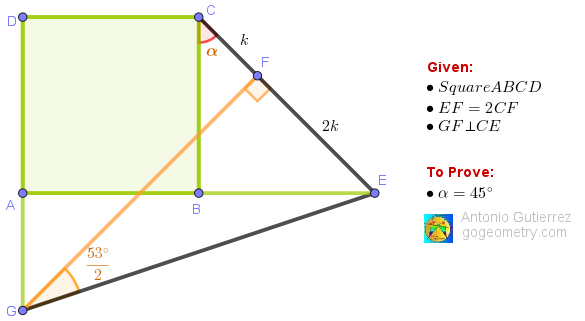
Target Audience: K-12, Honors Geometry, and College Mathematics Education.
Explore the full theorem and interactive diagrams by clicking the illustration below.
Technical Note on Notation
In classical geometry, 53/2° is the traditional shorthand for the angle whose tangent is exactly 1/2. While its decimal approximation is ≈ 26.565°, the synthetic beauty of Problem 1613 relies on the exact 1:2 ratio. For the purpose of this proof, 53/2° is defined as arctan(1/2), ensuring absolute mathematical rigor in the 2:1 relationship.
Click for additional details.
Proposed Solution
We invite students, teachers, and enthusiasts to share their proofs. This classic challenge can be approached using synthetic geometry.
How to contribute:
Post your step-by-step proof in the comments below. Feel free to:
We invite students, teachers, and enthusiasts to share their proofs. This classic challenge can be approached using synthetic geometry.
How to contribute:
Post your step-by-step proof in the comments below. Feel free to:
- Describe your construction and properties applied (centroid/medians).
- Provide a link to a diagram (GeoGebra, Desmos, etc.) if you have one.
Ready to contribute?
Please use the box below to Enter your Comment or Solution. You can use plain text or provide links to your diagrams.
Please use the box below to Enter your Comment or Solution. You can use plain text or provide links to your diagrams.


For angle BCE (alpha) to equal 45 degrees exactly as you'd like us to prove, the orange angle FGE must equal 26.5650511771, not exactly 26.5 as you claim in the diagram.
ReplyDeleteThe critical realization is that in triangle EFG, FG = 2EF, resulting in angle FGE having the classic value of arctan(1/2). If you round this to 26.5, however, the 2:1 ratio of FE:CF breaks alongside it. Thus, as currently written, this problem is impossible.
Technical Response: On Geometric Rigor vs. Nomenclature
ReplyDeleteThank you for your insightful observation. You are absolutely correct regarding the numerical precision: arctan(1/2) is indeed approximately 26.565051...° and not exactly 26.5°.
However, in the context of classical and synthetic geometry, there is a crucial distinction to be made:
Nomenclature: In many mathematical traditions (particularly in high-level competitive geometry), "53/2°" is used as the standard label or shorthand to denote the angle whose tangent is exactly 1/2. It is treated as a "notable angle" defined by its structural ratio rather than its decimal approximation.
The 1:2 Ratio: As you correctly identified, the heart of Problem 1613 is the exact 1:2 ratio in triangle EFG. In synthetic geometry, we prioritize these exact ratios over decimal degrees.
The Proof: If we define the angle as arctan(1/2), the consistency of the 2:1 ratio remains perfectly intact, and the proof holds with absolute mathematical rigor.
I appreciate you bringing this level of scrutiny to GoGeometry. It highlights why we focus on the "beauty of the ratio" over the "approximation of the degree." I have added a note to the problem description to clarify this for future visitors.
Thanks
Antonio Gutierrez
Lets side of square is "a",
ReplyDeleteWe can see that AFEG is cyclic, hence Angle FGE= Angle FAE = 53/2 , Draw FH perpendicular to BE ( H on BE),
We can see that FH=2BC/3=2a/3,
Also FH/AH=1/2 (Angle FGE= Angle FAE = 53/2), Hence
AH=2FH=4a/3, we get BH=4a/3 - a = a/3
Also CF/CE=1/3=BH/BE, or BE=3BH=a,
Hence Triangle CBE is right isosceles triangle with BC=BE, And Hence Angle BCE= 45 deg.
https://photos.app.goo.gl/6S5Uj5c75Nb5rRnE7
ReplyDeleteDefine NF , AB=AD=2a , connect AF
Let angle u= ∠(FGE) with tan( u)= ½ and u is approx. 53/2 degrees
AFEG are cocyclic => ∠( EAF)=u=(EGF)=∠(MFN)
Since tan(u)= MB/AB=MN/NF=½
So MB= a , CN=2a/3
MN=a/3 and NF=2a/3= CN
So CNF is an isosceles right triangle and alpha= 45 degrees
Let AF cut BC at Q and let P be on BC such that FP is perpendicular to BC
ReplyDeleteLet the square be of side t
Since < BAQ = 53/2, Triangle AQB is a special triangle with BQ = t/2 (approximately)
CP = t/3 and so PQ = t/2 - t/3 = t/6
Since GAFE is concyclic < FAE = 53/2 = < QFP
Hence PF = 2 X PQ = t/3 = CP
Therefore @ = 45
Sumith Peiris
Moratuwa
Sri Lanka