Geometry Problem. Post your solution in the comments box below.
Level: Mathematics Education, High School, Honors Geometry, College.
Click the figure below to view the complete problem 990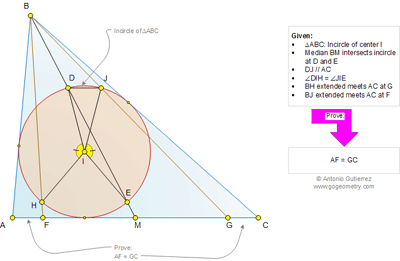
Thursday, March 6, 2014
Geometry Problem 990: Triangle, Incircle, Median, Cevian, Central Angle, Congruence, Circle, Secant, Midpoint


Subscribe to:
Post Comments (Atom)
Ver problema 2 aqui:
ReplyDeletehttp://metrigeo.blogspot.com.ar/
Solution problem 990
ReplyDeleteLet’s label some points and draw some lines in the given figure of this problem. Let K be the point of side AB tangent to the incircle, and L the same tangente point of side BC. Draw the line r parallel to AC passing by vertex B, and draw also the line KL, and extend it to get the intersection of line r and KL; call this point N.
Observe that the bundle B (AMCN) is harmonic because line r is parallel to AC and AM = MC. Call P the point of intersection of lines BM and KL. So the points KPLN are in harmonic division (each point belongs to a ray of the harmonic bundle). Also, remind that the line KL is the polar line of vertex B with respect to the incircle, and then points B, D, P and E are in harmonic division too.
As a result of the conclusions of previous paragraph, points B and N are harmonic conjugate of point P, also with respect to the incircle. So the polar of point P with respect to the incircle is the line r (the polar is a straight line and B and N belong to this line). It is known that the polar is perpendicular to the line joining the pole and the center of the circle. So line IP, is perpendicular to line r, and as line r and segments DJ and HE are parallel to AC, these segments are also perpendicular to IP. As the center of incircle I belongs to the perpendicular bisector of segments DJ and HE, and IP is perpendicular to these segments, then IP is the perpendicular bisector of both segments and then PD = PJ and PH = PE, and we conclude that triangles PDJ and PHE are similar, case AAA (angles DPJ = HPE, and JDP = HEP). To end this paragrapgh, draw the line HE, extending it to the right, and obtaining the point Q, intersection of lines HE and BJG. It is easy to see that triangles BDJ and BEQ are similar, case AAA (common angle at vertex B, and parallel sides DJ and EQ). With these “preliminaries” we are ready to end this problem.
In similar triangles PDJ and PHE, we have (DJ / HE) = (DP / PE) (1)
In similar triangles BDJ and BEQ, we have (BD / BE) = (DP / EQ) (2), but as poins B. D, P and E are in harmonic division as seen before, (BD / BE) = (DP / PE), and so by (1) and (2) we get (DJ / HE) = (DP / EQ) ; as numerators are the same, then
HE = EQ (3). So, by Thales Theorem aplied to segments HE, EQ and FM, MG, we get (HE / EQ) = (FM / MG), and by (3), we have FM = MG (4).
Finally, by the figure AF = AM – FM (5), and by the fact that M is midpoint of AC, AM = MC and by (4) FM = MG; replacing into (5), AM – FM = MC – MG = GC (6). By (5) and (6), AF = GC as was to be proved.
Joaquim Maia
Rio de Janeiro
Brazil